


Choosing ISO 17712 certified cable seals for trucks means more than finding a cable that passes through a door hasp. Buyers need to confirm the certification for the exact seal model, check fit at the intended access point, and make sure every number can be controlled from dispatch through delivery. These steps help cargo and compliance teams create a seal process that can be followed and documented on every movement.
Discuss your truck seal requirements
What does ISO 17712 tell a truck-seal buyer?
ISO 17712 is a standard for mechanical security seals used in freight transportation. It establishes classifications and testing requirements for seals, including the high-security classification buyers commonly need to evaluate for international cargo movements. The standard is not a general guarantee that a shipment cannot be tampered with, nor does a seal replace sound loading, access control, inspection, and recordkeeping.
The U.S. Navy's User's Guide on Security Seals for Domestic Cargo describes high-security seals in relation to ISO specification 17712 and emphasizes establishing verifiable controls. For a purchase, the useful takeaway is to check documentation that applies to the specific seal being quoted. A supplier's general statement about its product range is not enough to establish that every cable seal or size has the same classification.
Before ordering, ask for the current supporting documents for the exact product and verify that the product name, construction, and classification in the documents match the item on the quote. Keep the documents with procurement and compliance records. If an operating program or trading partner specifies additional conditions, compare those conditions separately rather than assuming an ISO classification answers every requirement.
When might a cable seal suit a truck movement?
A cable seal can be useful when the closure has an opening or routing path that works with a flexible cable and the team needs a tamper-evident closure that can be inspected after transit. Cable construction can give a buyer options for routing around suitable hardware, but flexibility alone does not establish the right security level or prove that a particular model meets a required standard.
Begin with the actual trailer or truck access point, not a generic product description. Look at the hasp, latch, door rods, and available openings. Confirm that the cable can pass through the intended hardware, that the seal body can sit in a visible position, and that the installed seal will not prevent normal door operation before sealing. Where door hardware differs across a fleet, check representative vehicle configurations before committing to a single specification.
Some shipments or closure designs may call for a different seal construction. A rigid bolt seal may be more suitable for compatible container or trailer hasps, while cable seals can be useful where the route through the hardware requires more flexibility. The right choice depends on the access point, the applicable security requirements, and the operating procedure. Compare the available cable seal options with bolt seal options and, for compatible configurations, review the truck and trailer seal collection.
How should buyers compare cable seals with other options?
Compare the intended use and evidence behind a product, not just its appearance. The table below is a starting point for discussing the options with operations, compliance, and procurement. It does not establish that a particular model is certified; confirm model-specific documentation and fit before purchase.
| Option | Where it may fit | What to verify | Operational consideration |
|---|---|---|---|
| High-security cable seal | Truck or trailer hardware with a suitable route for flexible cable | Exact model's ISO 17712 documentation, cable dimensions, locking body, and serial marking | Ensure cable routing and final placement remain visible and repeatable |
| High-security bolt seal | Compatible hasps or closures designed to accept a bolt-style seal | Exact model's classification documents, bolt dimensions, and compatibility with hardware | Confirm secure engagement and access to appropriate removal tools |
| Indicative plastic seal | Situations where a basic tamper-evident indicator meets the operation's requirements | Whether the required security level permits an indicative seal | Do not treat an indicative seal as equivalent to a high-security seal |
| Padlock or cargo lock | Reusable locking of suitable doors, gates, or equipment | Lock fit, key control, and whether the procedure also needs a single-use seal record | A lock and a serialized seal can serve different control purposes |
For the specific shipment, write down what the seal needs to accomplish: deter casual access, provide evidence of opening, meet a documented security requirement, or support an auditable handoff. More than one objective may apply. Teams may also need a separate physical lock for reusable access control. STiER's shipping container and trailer locks are a distinct product category; selecting a lock does not by itself provide the serialized, single-use record of a seal.
A useful comparison exercise is to map each candidate against the same real-world conditions. For example, list the trailer types in service, mark the sealing openings that staff can reach safely, and note whether the seal body can be checked without moving cargo or climbing into an awkward position. Then identify which models satisfy the written security requirement and fit those openings. A product that works on one trailer but cannot be installed consistently on another may require a separate approved option or a clearer exception process.
Which details should be checked before approving a model?
Use a short model-approval checklist and retain the answers with the approved specification. Ask the supplier to identify the exact product and provide documentation tied to that product, not a generic certificate detached from the quoted line item.
- Product identity: Capture the full model name, product code, and any configuration or size that appears on the quote.
- Standard and classification: Confirm the model's stated ISO 17712 status and the classification relevant to the use case. Ask for supporting documentation and check that it identifies the model being considered.
- Physical compatibility: Measure the usable opening and assess the intended route, body clearance, and visibility after installation. Consult the vehicle or trailer operator when the hardware is unfamiliar.
- Identification: Confirm how the seal number is marked and whether the number can be read and recorded at dispatch and receipt.
- Customization: If serialization, colors, or branding matter, specify them clearly and confirm how they affect the order and records.
- Removal: Decide who is authorized to remove the seal and what tools or procedures the receiving site needs.
- Program fit: Compare the model with customer, route, facility, and applicable security-program requirements. Do not infer that one certification automatically satisfies every buyer's procedure.
After collecting the documents, check that names and configuration details align across the quote, specification, and supporting evidence. If the quote lists a family of seals but the document names only one size or configuration, ask the supplier to clarify before approval. Save the final approved version where purchasing, operations, and compliance staff can find it. This avoids relying on an old email or a verbal assurance when a shipment is being prepared months later.
STiER offers several cable seal styles and sizes, including an aluminum cable seal in a 1/8-inch configuration, a 1/16-inch configuration, and a fixed-length steel cable seal. Those product links help identify possible construction and size options; they should not be read as a claim that any specific product is ISO 17712 certified. Confirm current product documentation and suitability for your application with the supplier.
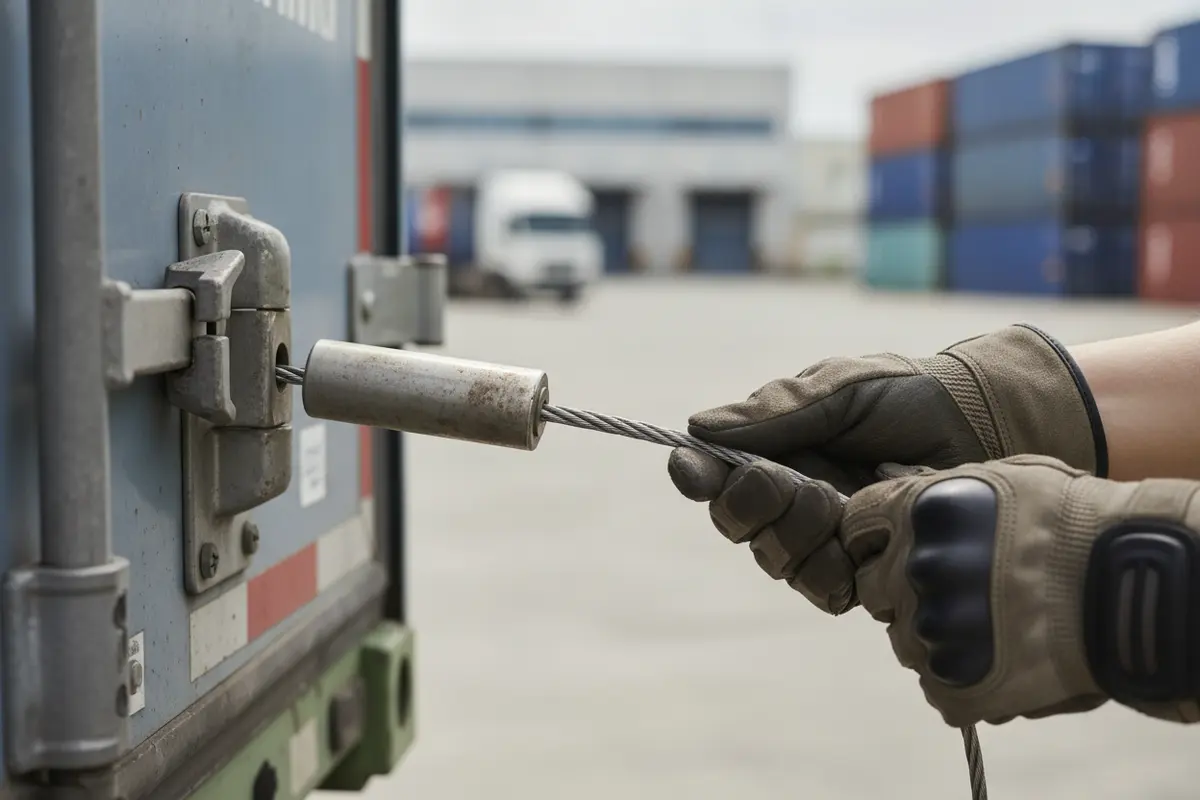
How can a team confirm fit at the truck door?
A seal that is difficult to apply correctly can produce inconsistent results across shifts or vehicles. Test the proposed configuration on representative door hardware before broad deployment. Follow the manufacturer's instructions and the organization's procedures; do not modify the seal or trailer hardware to force a fit.
- Identify the sealing point. Decide which opening or closure point the procedure requires to be sealed. Check that the selected point is actually part of the cargo access control, rather than an unrelated latch.
- Check dimensions and path. Verify that the cable can pass through the opening without being pinched or obstructed, and that the body can rest where staff can inspect it.
- Apply according to instructions. Use the specified method to engage and close the seal. Avoid improvised knots, bends, or alterations that could compromise installation or make inspection harder.
- Inspect the finished closure. Confirm that the seal is fully engaged, the doors are closed as intended, and the serial number is visible enough to read and record.
- Document the vehicle context. If a fleet uses different door or latch arrangements, note approved configurations and flag exceptions for review.
Practice the steps with the people who will apply and inspect seals. A simple work instruction should show the approved sealing point, the application sequence, the information to record, and the person to contact when hardware does not match. It can also make onboarding easier when employees work across multiple trailer types.
For a small pilot, select a few representative units rather than testing only the easiest door in the fleet. Include different latch arrangements or trailer makes that regularly carry covered loads. Have one person apply the seal and another inspect it using the planned checklist. If either person cannot read the number, see the body, or complete the normal door check without extra handling, record the issue and revise the fit decision before wider use. Keep the pilot findings with the approved specification so the choice reflects actual operating conditions.
How should teams manage serialized seals from dispatch to delivery?
A seal provides a useful control only when the team can connect the physical seal to a shipment and a responsible handoff. Establish who issues seals, who records them, how unused or damaged stock is handled, and how receiving staff compare the seal to the dispatch record. Keep the process practical enough for staff to follow during busy loading periods.
A dispatch record commonly needs the shipment or load reference, truck or trailer identifier, seal number, date and time, the name or role of the person applying it, and any relevant exception. The receiving check can record the seal number observed, the condition of the seal and door hardware, and the time and identity of the person checking it. The precise fields should reflect the organization's own controls and contractual or program obligations.
- Assign access to seal stock and records to designated roles.
- Record serial numbers at the point of application, rather than relying on memory after departure.
- Compare the received number with the dispatch number before opening whenever the process allows.
- Record discrepancies and preserve relevant shipment information for follow-up.
- Reconcile unused, voided, damaged, and removed seals according to the organization's written procedure.
Where multiple sites or partners handle a load, agree in advance on how the seal number and any exception will be communicated. For operations that manage broad cargo-control needs, STiER's 3PL and supply chain security selection and container and shipping seals pages can help teams review related product categories.
Consider a simple handoff example: dispatch records seal number 45821 on trailer 204, then sends the load reference and number to the receiving site through the agreed channel. At arrival, the receiver reads the physical number before opening and compares it with the dispatch record. If it matches and the seal and hardware appear intact, the receiver records the check and proceeds under the site's procedure. If the number is unclear, the person should document that fact and escalate rather than guessing or relying on a driver's recollection. This makes the record useful even when an exception occurs.
What should happen if a seal is missing, damaged, or mismatched?
A missing seal, visible damage, an unreadable number, or a mismatch between the physical seal and the dispatch record should be treated as an exception. It is not proof by itself that cargo was accessed, but staff should not ignore it or quietly replace the seal without recording what happened. Follow the company's security, customer-notification, and incident procedures.
- Pause the normal opening or handoff process where safe and operationally feasible.
- Record the location, time, vehicle or load identifier, seal condition, and the number observed or the reason it cannot be read.
- Photograph the seal and surrounding hardware if company policy permits and the scene can be documented safely.
- Notify the designated supervisor or security contact and follow required escalation steps.
- Document any authorized resealing, including the new seal number, who applied it, and who approved the action.
- Preserve records and supporting evidence in line with company procedures, customer requirements, and applicable rules.
Train drivers, dock teams, and receiving personnel on who must be contacted and what information to capture. Consistent response reduces confusion, protects the chain of information, and helps the responsible team decide what additional action is needed.
Make the exception instructions specific enough to use under pressure. A driver should know whether to remain at a designated location, who to call, and what details to provide. Receiving staff should know who can authorize opening, inspection, or resealing. If policy requires a safe operational exception, state how to record the reason and approval. Review completed incidents for recurring causes, such as unreadable markings or a mismatch between paperwork and seal stock, and address the process rather than treating each event as an isolated paperwork error.
What should an RFQ for truck cable seals include?
A complete request for quote helps a supplier understand the use case and helps your team compare like with like. Include enough context to confirm fit and documentation without assuming that the supplier can infer your operating requirements.
- Expected order quantity and whether orders will be recurring or split across locations.
- Truck, trailer, or door-hardware type and any known dimensions or fit constraints.
- Required standard and classification, with a request for model-specific supporting documentation.
- Preferred cable construction, length, or size where your application has a defined need.
- Serialization format, sequence requirements, colors, barcode needs, or branding, if applicable.
- Delivery destinations, timing, and any packaging or allocation requirements.
- Any customer, CTPAT, or internal process requirements that affect selection and evidence.
Ask which exact model the quote covers and whether its documentation matches the stated requirement. If the model or configuration changes, request updated confirmation before approval. STiER uses a quote-based sales approach for customized and volume-sensitive requirements. Use the contact page to request a cable-seal quote and share the operational details your team needs assessed. For a wider look at seals selected for regulated cross-border operations, review the customs and cross-border CTPAT collection.
To make supplier responses easier to compare, keep the request consistent across models. Ask each supplier to identify the precise configuration, state which documents will accompany or support the quote, and confirm any assumptions about cable dimensions, numbering, or customization. Separate required conditions from preferences. For instance, a required classification or fit constraint should be explicit, while preferred color can be identified as optional. When a fleet has mixed hardware, attach a short description or photos if company policy allows; this gives the supplier context without asking them to guess from the phrase “standard truck door.”
Request a quote for your truck application
What questions do buyers ask about ISO 17712 cable seals for trucks?
Does every cable seal meet ISO 17712?
No. Do not assume that a cable seal meets a particular classification because it is made of steel, has a serial number, or appears in a supplier's seal catalog. Ask for current documentation tied to the exact model and configuration under consideration.
Does a certified seal guarantee that a truck shipment is secure?
No single seal can guarantee shipment security. A properly selected and applied seal can form one part of a broader control process that includes access management, staff procedures, inspection, and reliable records.
Should a truck use a cable seal or a bolt seal?
Start with the door hardware and the applicable requirement. A cable seal may suit hardware that needs a flexible route, while a bolt seal requires compatible openings and engagement. Confirm model documentation, fit, visibility, application, and removal procedures before deciding.
Can a numbered seal replace a dispatch and receiving log?
No. A number is an identifier, not a record of who applied or inspected the seal or whether the number matched at delivery. Record the number with the load and document the handoff according to your procedure.
How can your team choose and source the right seal?
Start with the truck-door configuration and the security requirement, then shortlist models with documentation that supports the required classification. Test fit on representative hardware, define how serials will be recorded, and train the people responsible for application and inspection. Make exceptions part of the procedure instead of relying on informal decisions at the loading dock.
Contact STiER to discuss cable seal specifications and documentation
A clear specification helps your team compare suitable products, obtain the right supporting documents, and maintain consistent cargo controls from dispatch through delivery.