


When do operations need C-TPAT compliant trailer door seals? A seal is useful when a shipment's security plan calls for a visible, recorded indication that the trailer doors have remained closed after loading. The right choice depends on your route, cargo, door hardware, procedures, and applicable security requirements, not on the label alone.
Discuss your trailer seal requirements
What does a trailer door seal do in a cargo security plan?
A trailer door seal is a tamper-evident device applied at a trailer's access point after loading. It gives the shipper and receiving team a distinct identifier to record and inspect. If a seal is missing, visibly altered, or its identifier does not match the record, that difference can prompt a hold and investigation under the company's procedures.
A seal is not a substitute for a lock, a secure yard, access controls, or an inspection. It does not prove that cargo has never been accessed, and it cannot make a weak process secure by itself. A mechanical lock can resist unauthorized opening; a seal helps reveal a possible change in the secured condition and gives staff a number to verify. Some operations use both, assigning each a clear purpose.
For CTPAT-participating organizations, seal selection should fit the company's documented supply-chain security procedures and current program guidance. CTPAT is a voluntary partnership program with security expectations; it should not be treated as a blanket instruction that every trailer, route, and shipment must use one identical seal. Start with the security profile, shipment risk, and customer or regulatory requirements that actually apply to the movement.
STiER's guide to CTPAT seal requirements and its cross-border and CTPAT seal collection are useful starting points for planning a product discussion. Confirm current requirements with your compliance lead and the applicable program materials before treating any product as a compliance solution.
When should a team use a seal on trailer doors?
Use a trailer seal when a procedure, customer agreement, risk assessment, or applicable requirement calls for a controlled and verifiable closure. This commonly includes shipments where teams need to document the condition of the trailer from loading through handoff. The point is not to apply a seal indiscriminately; it is to define a consistent control at the point where cargo access matters.
- After loading: The loading team has completed the count or loading record, closed the doors, and is ready to release the trailer.
- At a custody handoff: A shipper or carrier needs to record which seal was applied and communicate that identifier to the next responsible party.
- For higher-risk or controlled cargo: A security plan or customer procedure specifies a seal and inspection process for the movement.
- For cross-border or trade-related movements: The organization's documented procedures or current applicable requirements identify a suitable seal and recordkeeping step.
- After an authorized inspection or access event: The original seal may need to be removed, recorded, and replaced according to the team's documented process.
These triggers should be written into the site's operating procedure. It should identify who may apply, inspect, remove, and replace seals; how discrepancies are escalated; and where records are kept. A seal is only useful to the operation when the people at loading, dispatch, transit, and receipt know what to do with it.
How do CTPAT compliant trailer door seals fit different operating situations?
The phrase CTPAT compliant trailer door seals can sound like a single product category, but the practical decision involves matching a device and process to a particular closure and movement. Begin with the seal's intended security level and the applicable specification, then check the product's documentation and the trailer's hardware. Do not assume a seal qualifies for a requirement just because it is marketed for cargo or international shipping.
For a high-security application, buyers often evaluate whether a bolt seal or another specified high-security seal fits the use case and has the required, verifiable certification. ISO 17712 is a standard relevant to mechanical seals used in international freight, but buyers should confirm the exact model's status and supporting documentation rather than extrapolate from a brand or product family. For other use cases, an indicative seal may support tamper evidence and identification without providing the same barrier function. The required level comes from the applicable procedure, not preference alone.
Door and latch compatibility matters too. Inspect the hasp openings, alignment, available clearance, exposure to weather, and the method authorized for removal. The seal must pass through the intended securing point and close correctly without interfering with the doors. If a trailer uses a locking bar arrangement or hardware that does not suit the selected seal, ask the supplier to review the application before ordering.
| Control option | Primary role | When to evaluate it | What to verify |
|---|---|---|---|
| Serialized tamper-evident seal | Provides an identifier and visible indication to inspect | When a documented process requires a recorded seal on the access point | Required security level, exact model documentation, fit, numbering, and removal procedure |
| High-security bolt seal | Provides a higher-security mechanical sealing option for compatible closures | When the applicable plan or requirement calls for a specified high-security seal | Certification for the exact model, application fit, serial control, and suitable removal tool |
| Padlock or cargo lock | Restricts opening while the lock is engaged | When physical access resistance is needed as part of layered protection | Trailer hardware compatibility, key control, operating procedure, and whether a seal is also required |
| Lock plus seal | Combines access resistance with a separately recorded seal identifier | When the security plan assigns distinct purposes to each control | Who controls the key, who records the seal, handoff steps, and how authorized access is documented |
This comparison is a planning aid, not a compliance ruling. Confirm any mandated type, standard, or level with the responsible compliance owner. STiER's bolt seals versus cable seals guide explains a separate product-selection question, while the truck and trailer seals range can help teams identify options to review. Exact product documentation still governs the final selection.
Which details should buyers verify before selecting a trailer seal?
Before requesting a quote, assemble the details that affect security, fit, identification, and repeatability. A short specification prevents a common mismatch: ordering a familiar seal without checking whether its physical form and documentation meet the actual use case.
- Required security level and basis. Identify the procedure, customer condition, or applicable standard that drives the requirement. If an ISO 17712 high-security seal is specified, verify that the exact seal model, not merely the supplier or product family, has the appropriate certification documentation.
- Closure design. Describe the trailer door hasp or locking point, including opening size, clearance, and any unusual hardware. Photos can help a supplier assess fit, but do not replace physical validation where needed.
- Seal construction and application. Specify whether the process calls for a bolt, cable, or other seal type. Consider installation and removal requirements, the environment, and whether authorized staff have compatible tools.
- Identification and serialization. Decide how the identifier will be recorded and checked. Ask about sequential numbering, barcode needs, or other customization only where it supports the company's process. Establish how numbers are issued, reconciled, and protected from unauthorized use.
- Volume and replenishment. Estimate usage by site, lane, and time period. Set a reorder point and designate who controls stock so a shortage does not lead staff to skip a required procedure or improvise with an unapproved substitute.
- Evidence and documents. State what certification, product specification, or compliance documentation procurement and security teams need to retain. Review current documents before approval and again when a model or specification changes.
STiER offers bolt seal options, cable seals, and plastic seals for different applications. These links are product-category starting points, not a statement that every item in a category meets every CTPAT or ISO requirement. Have procurement confirm the selected item's specifications for the intended use.
Request a review of your trailer seal specifications
How should teams apply, record, and inspect each seal?
A written seal-control sequence helps keep the number meaningful as a shipment changes hands. Use a consistent workflow that fits your operation, and train the people who load, dispatch, transport, receive, or inspect the trailer.
- Confirm the load and closure. Complete the loading checks required by the site procedure. Close the doors fully and examine the securing point for damage or obstruction.
- Apply the approved seal. Use the correct model and attachment point. Follow its installation instructions, and check that it is fully engaged. Do not alter a seal or reuse a single-use device.
- Record the identifier immediately. Enter the serial number, trailer or shipment reference, date and time, location, and responsible person's identity in the approved record. Follow the organization's rules for handling these records.
- Share the information securely. Provide the identifier to the carrier or receiving party through the approved communication channel. Limit access to seal stock and records according to company procedures.
- Inspect at handoff and receipt. Compare the seal's identifier and apparent condition with the record before opening. Follow escalation procedures for a mismatch, damage, missing seal, or unexplained substitution.
- Document authorized removal or replacement. Record who removed or replaced the seal, why access was needed, and the old and new identifiers when applicable. Maintain a clear trail rather than overwriting the first entry.
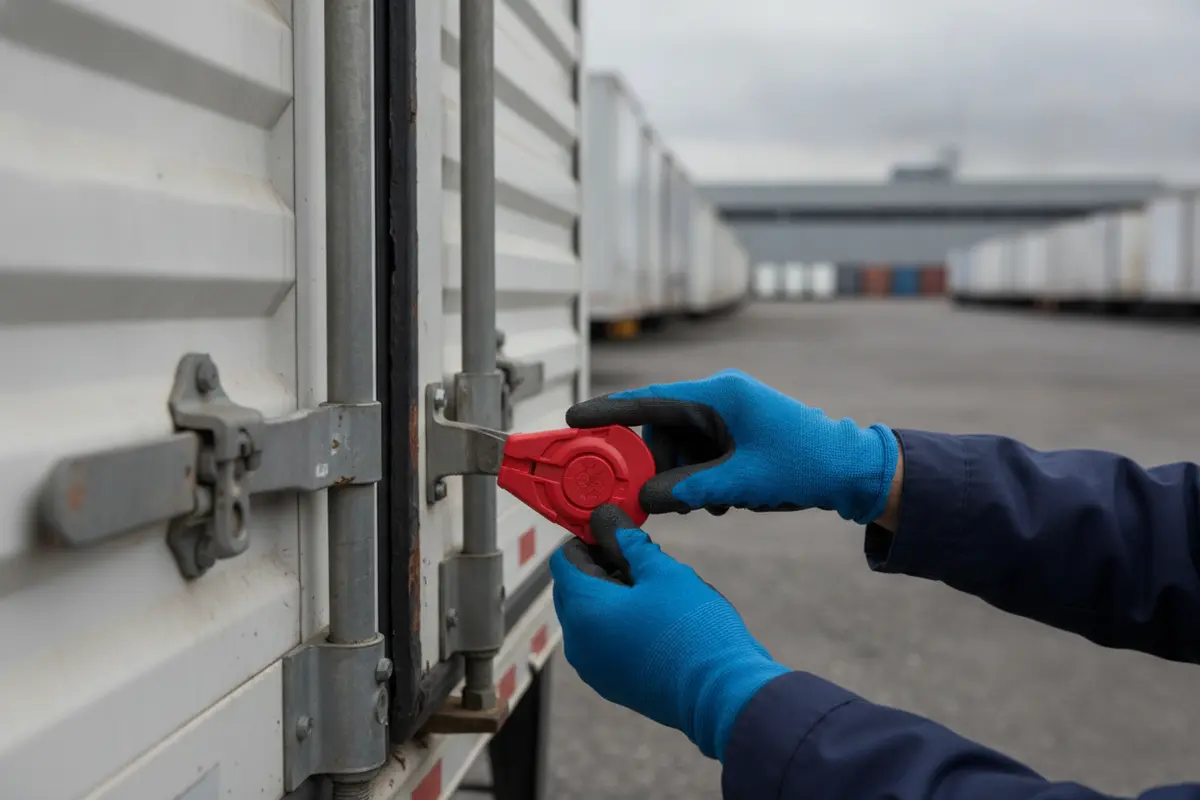
CBP's seal requirements for manufacturers describe responsibility for a sealed container or trailer until a carrier assumes control, and discuss affixing seals. That guidance is relevant context for custody handoffs, but it is not a substitute for reviewing the requirements that apply to your own program, route, or shipment. Build handoff responsibility into written procedures so the transfer is clear.
For additional application context, see STiER's information on 3PL and supply-chain security and container and shipping seals. The correct process should remain usable at each location, including during shift changes and after exceptions.
For example, a distribution center can test its routine with a short tabletop handoff: the loader records a seal number, dispatch passes it to the carrier, and receiving checks it against the shipping record before opening. Ask each participant to explain where the identifier is found, who to call for a mismatch, and how an approved inspection is recorded. If any step depends on memory or an informal message, revise the written workflow and practice it again. A pilot on one lane can reveal unclear ownership or unsuitable door hardware before a process is applied across more sites.
What should happen when a seal is damaged or the number does not match?
Treat a discrepancy as an exception that needs review, not as proof by itself that theft or tampering occurred. The receiving or inspection team should avoid opening the trailer until the responsible supervisor or security contact is notified, unless an immediate safety or legal need requires action. Follow the company's escalation procedure and preserve relevant records.
Document the observed condition and the identifier shown in the record, along with time, location, people notified, and actions taken. If a seal is broken for authorized inspection, record who authorized it and which replacement seal was applied. Where appropriate, retain photos and other shipment records under the organization's evidence-handling policy. Notify the carrier, shipper, customer, or authorities as directed by the applicable process.
Investigate process causes as well as possible security concerns. A transcription error, an unrecorded seal change, a dispatch delay, or a poorly communicated handoff can produce a mismatch. Review stock issuance and access to serial-number records, then correct the underlying control. The goal is a reliable chain of documentation and a consistent response, not an assumption about cause.
A useful exception review separates immediate containment from later analysis. First, secure the trailer and confirm who has authority to decide whether it can be opened. Next, compare the dispatch record, carrier handoff information, and receiving entry without editing the original record. Note whether the physical seal appears intact, whether its number is legible, and whether the trailer or shipment reference matches. After the authorized response, reconcile unused and replacement seals from controlled stock. A brief review of repeated exceptions can reveal training, communication, or record design problems; it should not replace case-specific investigation or the organization's reporting rules.
What should an RFQ include for CTPAT trailer door seals?
A useful request for quote gives the supplier enough information to recommend compatible options without asking it to make your compliance decision. Include the expected quantity and delivery cadence, destination, use case, closure details, required security level, and any documentation your compliance team needs. State whether serialization, barcodes, color, or other identification features are required, and clarify whether those are mandatory or preferences.
Ask the supplier to identify the exact proposed model and provide current product specifications and applicable certification documents. Request confirmation of the seal's installation and removal requirements, compatible tools, and any limits relevant to your application. If the order is recurring, explain how you want numbering handled and how repeat orders should align with the existing control process. Pricing for customized or volume-based requirements may be quote-based; compare the full order specification rather than an unqualified unit price.
Procurement, security, operations, and compliance should review the same specification before approval. A product may physically fit but fail to meet an organization's documented security level; another may meet the stated requirement but be awkward for staff to apply consistently. Resolve both issues before rollout, then sample the process at a working site.
For purchase planning, STiER's security seal collection provides a further overview. Send your application and documentation questions through the STiER contact page so the team can respond to the specific seal and order requirements.
Confirm the right seal and documentation for your operation
What questions do buyers ask about CTPAT compliant trailer door seals?
Does every CTPAT shipment require the same trailer seal?
No single product choice should be assumed for every shipment. Follow your company's current CTPAT security procedures and any other requirements that apply to the load, route, customer, or jurisdiction. Ask the compliance owner to confirm the required seal type and level for the particular operation.
Does a seal replace a trailer lock?
No. A seal supports identification and inspection of a closure, while a lock is intended to restrict access when secured. They have different roles. Use one or both according to the security plan, and ensure staff understand which device must be checked and recorded.
Is any serialized seal automatically ISO 17712 certified?
No. Serialization identifies an individual seal, but does not establish its certification. Confirm the exact product model and its current documentation when an ISO 17712 high-security seal is required.
What should a driver do if the seal number differs from the paperwork?
Follow the carrier and shipper escalation procedure before opening the trailer, where conditions allow. Record the discrepancy and notify the designated security contact. Do not replace or discard the seal without documenting the event and following the authorized process.
How can an operation put the right seal process in place?
Start by mapping the trailer's access point, the shipment's security requirements, and the custody handoffs. Select a compatible seal with documentation that matches the stated requirement, then establish controls for application, serial-number records, stock, inspection, exceptions, and replacement. Revisit the process when equipment, lanes, requirements, or products change.
Talk with STiER about your trailer seal application
With a clearly specified product and a repeatable record-and-inspect routine, teams can make trailer seals a practical part of cargo security rather than a disconnected purchasing choice.