


A refrigerated shipment can arrive with an intact seal and still have suffered a temperature excursion. Cold-chain logistics teams need two connected controls: a tamper-evident, serialized seal to document physical access and a logger or sensor to document environmental conditions.
Contact STiER for cold-chain security guidance.
Effective cold chain logistics security seal temperature controlled cargo monitoring combines a serialized security seal, an appropriate temperature logger or sensor, and a documented handoff process. The seal provides evidence of unauthorized access or substitution. The monitoring device records whether cargo stayed within its required range. Reviewing both records gives carriers, receivers, and compliance teams a clearer basis for release, quarantine, or investigation.
This article focuses on the security layer around refrigerated trailers, containers, and temperature-sensitive cargo. For the broader control framework, see STiER's supply chain compliance and security operations guide. The cold-chain boundary is specific: this article does not treat a seal as a temperature instrument, and it does not replace a product-specific quality or regulatory procedure.
What Makes Cold Chain Logistics Security Different From Standard Cargo Security?
Cold-chain logistics security has two independent failure modes: unauthorized access and loss of the required temperature condition. STiER security seals address the first by making a closure change visible and traceable. A separate logger or sensor addresses the second by creating an environmental record. Neither control can substitute for the other.
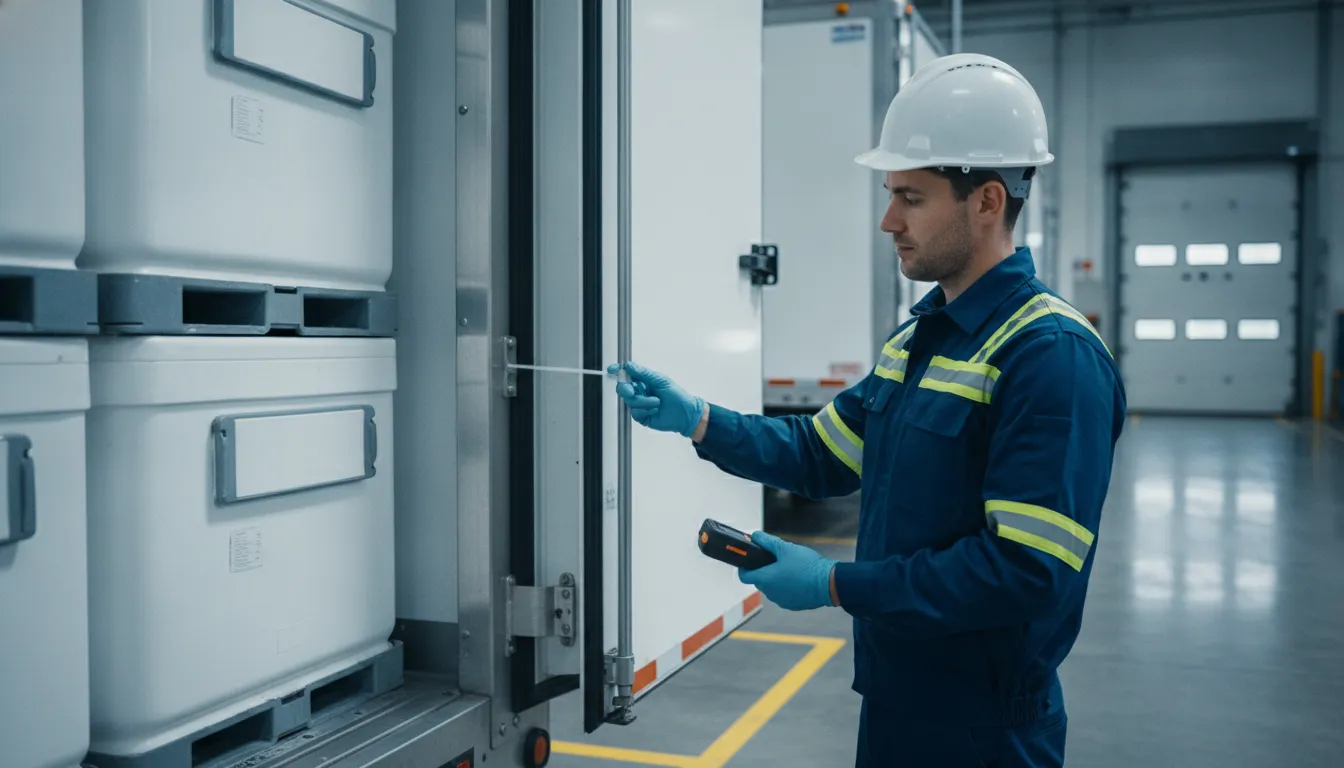
A reefer door is a control point during loading, inspection, cross-docking, customs processing, and delivery. Authorized personnel may need to open it, but each opening should have a reason, an accountable person, and a corresponding record. If the seal is broken, missing, damaged, or different from the dispatch record, the receiver has a defined reason to pause before unloading.
Why is a closed reefer door not enough?
A closed latch shows the condition of the door at one moment. It does not establish who accessed the cargo between handoffs or whether the door was properly secured after an authorized inspection. A tamper-evident seal links the closure to a unique identifier in the shipment record. That comparison can expose a substituted seal, an undocumented opening, or a mismatch that requires review.
Temperature control must remain a separate evidence stream. A clean seal does not rule out a failed refrigeration unit, a loading delay, poor airflow, or an inactive logger. Conversely, an acceptable temperature history does not explain a broken seal. This separation prevents teams from accepting a shipment based on the wrong evidence.
Which events should the control process cover?
- Seal application and logger activation at the shipping facility.
- Carrier pickup, cross-dock transfers, customs inspections, and other authorized access events.
- Seal and identifier checks at each documented handoff.
- Receiving inspection before refrigerated cargo is released or unloaded.
- Exception review when a seal, record, device, or temperature reading does not match the plan.
Teams that already use a broader security seal buying guide can apply the same control logic here, then add the monitoring and quality requirements that cold-chain cargo demands.
Which Security Seal Types Work Best in Refrigerated Trailer Environments?
The best seal depends on the reefer door design, locking points, access risk, inspection visibility, and the evidence required after delivery. STiER's trailer and transport security seals collection can help teams compare formats, but physical fit and the operating procedure should be confirmed before ordering.
| Seal option | Best-fit use | Control value | Selection question |
|---|---|---|---|
| High-security bolt seal | Compatible container or trailer door locking points on higher-risk lanes. | Creates a visible, tool-removable barrier and supports inspection against a recorded number. | Does the door accept the bolt, and is ISO 17712 relevant to the lane? |
| Steel cable seal | Closures where a flexible cable can pass through the available locking points. | Works around varied geometry while preserving tamper evidence and serialization. | Can staff inspect the cable path and identify damage quickly? |
| Indicative plastic seal | Lower-risk access points or workflows needing a fast visual check. | Shows obvious removal or alteration and supports quick reconciliation. | Is an indicative format suitable for the cargo value and access risk? |
| Serialized seal control | Any repeatable reefer or container program. | Connects a seal number to a unit, shipment, route, handoff, and exception record. | Who issues, records, reconciles, and authorizes replacement numbers? |
Serialization is a process layer, not a product classification. A serialized seal can strengthen accountability only when the number is recorded before departure and checked at receiving. If a seal must be replaced, record the original number, reason, authorizing person, replacement number, time, and location. Do not discard the old identifier without an explanation in the shipment record.
For international cargo, confirm whether the route or customer program requires an ISO 17712 high-security seal. CTPAT-oriented operations also need written procedures, inspection, training, and audit records. The exact requirement depends on the cargo, lane, facility, and security program. A seal supplier should provide model-specific documentation rather than making a broad cold-chain claim.
What should a buyer inspect before application?
- Confirm the seal fits every intended locking point without obstructing safe operation.
- Check that the identifier is readable and matches the number issued to the shipment.
- Inspect the door, latch, and surrounding hardware for pre-existing damage.
- Apply the seal according to the written procedure and record the responsible employee.
- Document an exception when the process requires visual evidence.
The physical seal protects the access-control decision. The logger protects the temperature decision. Keeping those decisions distinct is the core of a defensible cold chain logistics security seal temperature controlled cargo monitoring program.
How Does Cold Chain Logistics Security Seal Temperature Controlled Cargo Monitoring Work?
Cold chain logistics security seal temperature controlled cargo monitoring works when the seal record and temperature record are created at the same shipment milestones. Then reviewed together at handoff and receipt. STiER recommends treating the seal as evidence of access control and the logger as evidence of environmental history, with a named owner for each exception.
- Define the product and route requirements. Record the product's required temperature range, shipment duration, handoffs, equipment type, and receiving decision rules. Do not infer a range from the seal or from a generic cold-chain label. The product owner or quality team should provide the applicable requirement.
- Inspect and seal before departure. Check the closure and locking points, apply the approved serialized seal. And record the seal number with the trailer or container identifier, shipment reference, loading time, and employee name.
- Activate the logger or sensor. Place the device according to the monitoring plan and manufacturer instructions. Confirm that it is recording before the doors close. NIST publishes methods for accurate cold-chain monitoring using digital data-loggers, which can inform a measurement procedure: NIST cold-chain data-logger methods.
- Document every handoff. At pickup, transfer, inspection, and delivery, record time, location, seal condition, identifier, and any authorized opening. Keep the logger identifier with the shipment record so the environmental file can be matched to the physical load.
- Review the two evidence streams at receiving. Before unloading, compare the seal with the dispatch record and inspect for tampering. Review logger readings, gaps, alerts, and out-of-range events. A matching seal does not clear a temperature alert, and a clean temperature history does not clear a seal discrepancy.
- Reconcile exceptions before disposition. Escalate a mismatched number, broken seal, missing record, inactive device, or out-of-range reading under the applicable quality procedure. Preserve the evidence and document whether the shipment was released, quarantined, sampled, or otherwise reviewed.
For pharmaceutical operations, monitoring and security records may support a larger quality system involving DSCSA, GDP, FDA, DEA, or customer requirements. This article does not assign a legal disposition to a shipment. It provides a practical control structure that lets the responsible quality and compliance teams review the facts.

Ask STiER about serialized seals for your cold-chain handoff process.
How Does Seal Integrity Support Cold Chain Compliance and Accountability?
Seal integrity supports cold-chain compliance by making access control visible, repeatable, and auditable. It does not certify product safety, prove a temperature range, or replace a regulatory program. The value comes from connecting a physical inspection to a written procedure and a unique shipment record.
How do CTPAT and ISO 17712 fit together?
CTPAT is a supply-chain security program with organizational controls such as written procedures, responsibilities, training, inspections, and records. ISO 17712 establishes a classification and testing context for mechanical freight container seals. They can work together, but one does not replace the other. A qualifying seal still needs to be selected, applied, recorded, and inspected under the company's process.
For CTPAT-oriented operations, the seal log should make it possible to trace the seal from issuance through receiving. The procedure should also explain how staff respond to a broken, missing, or substituted seal. STiER's supply chain compliance and security operations guide provides the wider program context; this article narrows that framework to temperature-controlled cargo.
What records make an exception review useful?
- Shipment, trailer, container, route, and product references.
- Original seal number, application details, handoff checks, and replacement history.
- Logger or sensor identifier, activation status, readings, alerts, and gaps.
- Names or roles of people who opened, inspected, transferred, or received the load.
- Disposition, corrective action, and supporting evidence for each exception.
A complete record gives a compliance manager something more useful than a statement that the load was secure. It shows what was checked, when it was checked, what differed from the plan, and who made the release decision.
How Can You Choose a Cold-Chain Security Seal Supplier?
Procurement teams should treat "cold-chain-rated" as a claim to verify. Ask the supplier to separate seal performance from temperature-monitoring performance and to document the conditions under which the product was tested. STiER's security seal applications can help buyers frame the discussion around equipment, access points, serialization, and the intended operating environment.
Which supplier evidence should you request?
- Model-specific classification, test, and certification documentation where applicable.
- Material, dimensions, removal method, and compatibility with the reefer or container closure.
- Serialization and customization options, including numbering and barcode requirements.
- Guidance for application, inspection, replacement, reconciliation, and audit records.
- Supply continuity information, including lead-time planning and substitution controls.
Send the supplier the equipment types, locking points, cargo risk, route profile, expected volume, certification needs, and current seal-control procedure. Ask for a quote based on that operating context. STiER's model selection should be evaluated with the rest of your security process, not as a stand-alone promise that a physical seal measures temperature.
Also define how the program will be managed after the first order. Assign ownership for unused seal inventory, number reconciliation, damaged units, and emergency replacements. Keep the approved model and its documentation tied to the procedure so a substitute is not introduced without review. For multi-site operations, use the same terminology for seal status, handoff, and exception escalation across warehouses, carriers, and receiving teams. These controls make the supplier relationship useful beyond the initial purchase: they help procurement, security, and quality teams maintain one traceable process as lanes and facilities change.
Request a tailored cold-chain security seal review from STiER.
Frequently Asked Questions
Can a security seal prove that cargo stayed within its temperature range?
No. A tamper-evident seal shows evidence of access or alteration. It does not measure temperature. Pair it with an appropriate logger or sensor and review the environmental record with the seal and handoff records.
What should be recorded when sealing refrigerated cargo?
Record the trailer or container identifier, shipment reference, seal number, application time, location, and responsible employee. At each handoff, record the seal condition, number, time, location, and any exception. Reconcile the record at receiving.
Are ISO 17712 seals enough for cold-chain compliance?
Not by themselves. ISO 17712 concerns mechanical seal classification and testing. A cold-chain program also needs product requirements, monitoring, documented access procedures, inspections, training, exception handling, and receiving controls.
What happens if the seal is intact but the logger shows an excursion?
Escalate the temperature event under the applicable product and quality procedure. An intact seal can show that the closure was not obviously altered, but it cannot clear an environmental excursion or determine whether cargo is acceptable.
What should a supplier provide besides physical seals?
Ask for model-specific documentation, fit guidance, serialization options, application and inspection procedures, replacement controls, supply continuity information, and a quote based on your equipment and operating lanes.
How Can STiER Support Your Cold-Chain Seal Process?
A strong cold-chain process keeps access evidence, temperature data, and handoff records connected without confusing their roles. STiER supplies serialized security seals and practical application guidance for logistics, cargo, and supply-chain programs. Contact the team to discuss your equipment, route, documentation, and security requirements.
Contact STiER to discuss your cold-chain security seal requirements.